In the EAL Grade 2 class this week, in anticipation that many of our language learners would be writing emotions poems at some point in the next week, we began to inquire into the following question:
"How do good writers make their writing more interesting?"
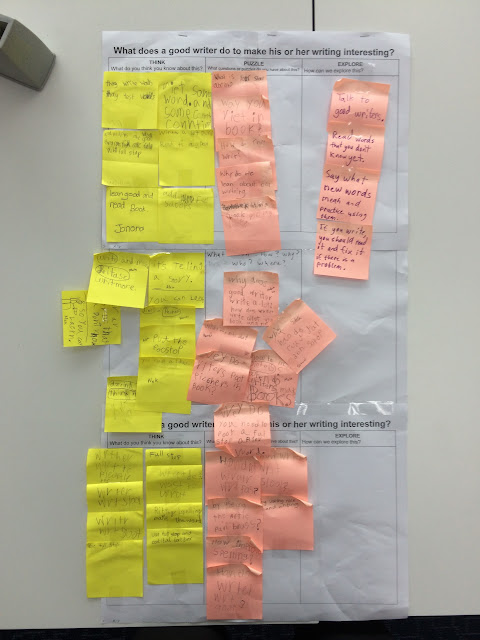
After positing this question, Ms. Mom, Ms. Boramey and I immediately divided the students into three groups in order to go through a Visible Thinking Routine with the children entitled Think Puzzle Explore.
In working through this thinking routine, students were asked to write down what they already thought they knew about the answer to our question and what puzzled them about the question. We then, as a group came up with ideas on how we could explore finding answers to this question. As you can see below, student groups came up with many ideas on what good writers needed to do. In the larger class group, we zoomed in on one students assertion that good writers added lots of details. Other students then asked questions like:
We then devised lessons which we hoped would give students more proficiency with language tools that would allow them to quickly add more details to their writing, mainly be making it more descriptive. Our goal was also to give them ideas for improving as writers that would transfer to work they were doing in homerooms related to writing poems about emotions. We decided that students would benefit from doing a bit of work with interesting adjectives and prepositions of place that they could use in describing while writing.
First, we created a Mix activity, in which we gave students either a describing word (adjective) or a thing (noun) on a piece of paper. We echo read all the words as a class and then asked students to circulate around the room reading out loud, sharing, and exchanging their words with each other for about 3 minutes in order to expose students to a variety of language with which they might not already be familiar. We then asked students to stop, and make a guess as to whether their word was a noun, something you could touch, take or draw a picture of, and/or see/hear/taste/feel/smell. We then asked students to come stick their words under the heading of NOUN (Thing) or ADJECTIVE (Describing word). This produced many interesting results which made us as teachers aware that students were very confused as to not only adjective forms and endings, but what actually constitutes "a thing". As teachers, we decided students would need to do a little more exploration of these concepts.

The next lesson, we had students refocus on the fact that we were learning ways to make our writing more interesting, and were really going to concentrate today on building up some knowledge of words that could be used to describe how something tastes, looks, sounds, smells, and feels. Students again mixed and exchanged words, this time only adjectives, before going to meet with a teacher who shared a number from 1-3 that students found on their individual words. In these three groups, students and teachers classified words based on which of the five senses they helped describe, and then we shared our sorts with the class.

Next steps? Now to link it all up! Next week students will do a partner sort at their desk, matching appropriate adjectives of taste, smell, touch, sight, and sound to relevant nouns before completing an exit ticket or drafting and revising poems that are extensions of what students are writing in their homerooms! Students will also engage in a writing/treasure hunt activity to give them practice with identifying location.
"How do good writers make their writing more interesting?"
After positing this question, Ms. Mom, Ms. Boramey and I immediately divided the students into three groups in order to go through a Visible Thinking Routine with the children entitled Think Puzzle Explore.
In working through this thinking routine, students were asked to write down what they already thought they knew about the answer to our question and what puzzled them about the question. We then, as a group came up with ideas on how we could explore finding answers to this question. As you can see below, student groups came up with many ideas on what good writers needed to do. In the larger class group, we zoomed in on one students assertion that good writers added lots of details. Other students then asked questions like:
- How did good writers add details?
- How did they write so fast?
- How did they write so much?

We then devised lessons which we hoped would give students more proficiency with language tools that would allow them to quickly add more details to their writing, mainly be making it more descriptive. Our goal was also to give them ideas for improving as writers that would transfer to work they were doing in homerooms related to writing poems about emotions. We decided that students would benefit from doing a bit of work with interesting adjectives and prepositions of place that they could use in describing while writing.
First, we created a Mix activity, in which we gave students either a describing word (adjective) or a thing (noun) on a piece of paper. We echo read all the words as a class and then asked students to circulate around the room reading out loud, sharing, and exchanging their words with each other for about 3 minutes in order to expose students to a variety of language with which they might not already be familiar. We then asked students to stop, and make a guess as to whether their word was a noun, something you could touch, take or draw a picture of, and/or see/hear/taste/feel/smell. We then asked students to come stick their words under the heading of NOUN (Thing) or ADJECTIVE (Describing word). This produced many interesting results which made us as teachers aware that students were very confused as to not only adjective forms and endings, but what actually constitutes "a thing". As teachers, we decided students would need to do a little more exploration of these concepts.

The next lesson, we had students refocus on the fact that we were learning ways to make our writing more interesting, and were really going to concentrate today on building up some knowledge of words that could be used to describe how something tastes, looks, sounds, smells, and feels. Students again mixed and exchanged words, this time only adjectives, before going to meet with a teacher who shared a number from 1-3 that students found on their individual words. In these three groups, students and teachers classified words based on which of the five senses they helped describe, and then we shared our sorts with the class.

Next steps? Now to link it all up! Next week students will do a partner sort at their desk, matching appropriate adjectives of taste, smell, touch, sight, and sound to relevant nouns before completing an exit ticket or drafting and revising poems that are extensions of what students are writing in their homerooms! Students will also engage in a writing/treasure hunt activity to give them practice with identifying location.


